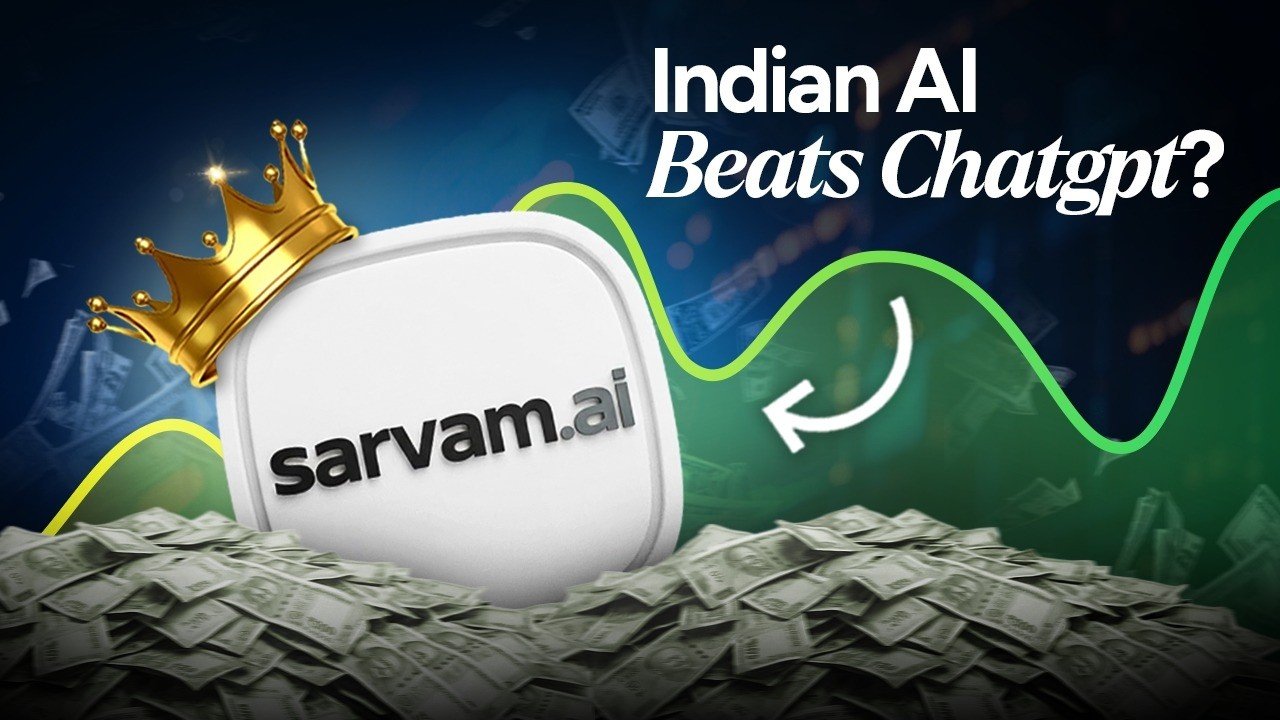
In a groundbreaking development, Seram AI, a 2.5-year-old Indian AI startup, has achieved a remarkable feat: outperforming global AI giants like ChatGPT and Google Gemini on India’s specific AI benchmarks. This accomplishment is particularly impressive given Seram AI’s modest funding of just $41 million, a mere fraction of what its trillion-dollar competitors command. Furthermore, Seram’s AI model boasts a lean 3 billion parameters, a stark contrast to Google Gemini’s estimated 2 trillion parameters, making Seram’s model a staggering 667 times smaller. This pivotal moment for India’s AI landscape signals a fascinating future for artificial intelligence in the country.
The latest edition of the popular Indian startup news show, Backstage with Millionaires, a channel within the Zerodha’s network, recently celebrated its 300th episode. This milestone represents over five years of dedicated weekly news coverage. The show’s host expressed gratitude for the audience’s consistent support and enthusiasm, hoping to continue delivering exciting news about the Indian startup ecosystem for many more years. The show also invited audience members to share when they began watching the weekly startup news videos.
Seram AI’s Unprecedented Achievements
Before delving into Seram AI’s broader strategy, let’s highlight its recent, impactful victories:
- Seram Vision: Document Reading AI
Seram Vision achieved an impressive 84.3% accuracy on the OM OCR benchmark for document reading. This score surpasses Google Gemini 3 Pro (80.2%) and ChatGPT (69.8%). This isn’t just any test; the benchmark specifically measures an AI’s ability to accurately read real Indian documents, including handwritten government forms, financial records from the 1980s, textbooks in regional languages, and newspapers with poor scan quality. Seram’s AI demonstrated superior performance in deciphering these complex and often messy documents, which pose a significant challenge for machines. - Bulbull V3: Text-to-Speech Model
Seram’s text-to-speech model, Bulbull V3, dominated critical telephony-grade audio tests, essential for the Indian market. In a blind study involving over 20,000 votes from 500 participants, Bulbull V3 emerged as the top-rated model for 8 kHz audio, the standard used by call centers and voice agents. While global competitors like ElevenLabs excel in studio-quality audio, Bulbull V3 showcased its strength in the low-bandwidth, real-world conditions prevalent in Indian businesses.
The “How”: Seram AI’s Strategic Approach
The question that naturally arises is how Seram AI achieved this success against such formidable odds. Seram AI didn’t attempt to outcompete general-purpose models like ChatGPT across the board. Instead, they posed a different, more focused question: “What does India genuinely need that global models currently fail to address effectively?”
The answer was clear: the ability to accurately read Indian scripts, speak Indian languages with natural accents, and deeply understand Indian cultural contexts.
Training Data and Custom Tokenizers
Global AI models are typically trained on vast datasets drawn heavily from Western sources like Reddit, Wikipedia, GitHub, and predominantly English books, with approximately 90% of their training data being in English. Consequently, these models encounter significant difficulties when presented with a government form in Tamil, complete with coffee stains and handwritten notes, or when asked to speak Hindi with a natural accent while handling code-mixed English. They often produce less natural-sounding speech for Indian languages.
Seram AI tackled this challenge by exclusively training its models on rich, diverse Indian data. This includes real government forms, banking documents, textbooks in 22 regional languages, historical newspapers and archives dating back to the 1800s, voice recordings with authentic regional accents, and code-mixed speech patterns.
Beyond data, Seram AI also developed custom tokenizers. This foundational technology is specifically optimized for breaking down Indian scripts. Standard tokenizers process scripts like Devanagari or Tamil with considerable inefficiency, often requiring two to three times more processing than English. Seram AI addressed this inefficiency at a fundamental level, providing a more robust base for its models.
Building India’s Sovereign AI Infrastructure
Seram AI is now actively constructing India’s sovereign AI infrastructure, in close collaboration with the government. In April 2025, Seram AI was selected as the first startup under the India AI Mission, tasked with developing India’s foundational large language model. The government is providing Seram AI access to 4,000 GPUs for six months and taking an equity stake in return. The Indian government views this as a strategic investment, recognizing homegrown AI as vital for national security and digital sovereignty.
In January 2026, this collaboration expanded significantly with the announcement of Digital SAUM by Seram AI, IIT Madras, and the Tamil Nadu government. This initiative marks India’s first sovereign AI research park, backed by a 10,000 crore rupees investment over five years. Digital SAUM will house advanced research laboratories, startup incubation facilities, an institute dedicated to AI and governance, and a 20-megawatt AI-optimized data center. Seram AI has also signed a Memorandum of Understanding (MOU) with the state of Odisha to establish a 50-megawatt AI compute facility there.
Furthermore, Seram AI is partnering with the Unique Identification Authority of India (UIDAI), the entity responsible for the Aadhaar digital identity program, to power AI voice interaction for 1.38 billion Indians. This robust strategy for sovereign AI aims to mitigate India’s dependence on American or Chinese AI for critical government services, positioning Seram AI as a crucial solution to this potential strategic vulnerability.
A Master of Specificity, Not a Jack of All Trades
It is important to clarify that Seram AI has not surpassed general-purpose models like ChatGPT in every domain. For instance, Seram Vision is not designed for tasks such as poetry generation, explaining quantum mechanics, or coding. As an India Today article perfectly articulated, while models like ChatGPT and Gemini serve as ‘jacks of all trades,’ Seram AI has established itself as a ‘master of a few highly specific ones.’
What Seram AI has profoundly demonstrated is that for specific, India-focused applications, a focused startup, with the right strategic approach, can indeed outperform even trillion-dollar companies operating with vast trillion-parameter models. This underscores the principle that success in AI is less about building the biggest model and more about crafting the right solution for a particular need.
Founders’ Vision: Building for Indian Enterprises
This strategic approach is deeply rooted in the unique backgrounds of Seram AI’s founders. Pratyush Kumar, with a background in Microsoft Research and IBM Research, also co-founded AI for Bharat, an organization dedicated to Indian language AI for many years. Vivek Raghavan, who holds a PhD from Carnegie Mellon, dedicated nearly 12 years as a volunteer architect for Aadhaar. Both founders possess not only profound technical expertise but also a strong passion for developing India-specific products.
They recognize the futility of direct competition with general-purpose models like ChatGPT and Gemini. Consequently, their focus is not on everyday consumers but on developing robust solutions tailored for Indian enterprises, large businesses, and government entities. Their products include Servey, an agent orchestration platform specifically designed for these sectors.
Seram AI’s pricing strategy is also optimized for the Indian market. Their voice AI agent is priced at just one rupee per minute, a significant saving compared to global services which can be two to five times more expensive. Seram AI is already collaborating with major clients such as UIDAI for Aadhaar services, various state governments, and numerous large Indian corporations. Their strategy is straightforward: while global giants like OpenAI and Google contend for general-purpose chatbot dominance among consumers worldwide, Seram is strategically constructing the essential AI infrastructure required by Indian enterprises, addressing needs like document processing for banks handling millions of forms, voice AI for call centers serving rural India, and translation services for government entities reaching non-English speakers.
Finanjo AI: Your Personal Financial Advisor
In a parallel effort to address India’s unique needs, the team behind Backstage with Millionaires has launched Finanjo, an app designed to simplify personal finance for millions of young Indians. This week, Finanjo introduced its new AI feature. The Finanjo AI feature, which connects to users’ real financial data, offers personalized insights and advice tailored to individual financial situations, moving beyond generic, one-size-fits-all recommendations.
For example, users can ask, “Can I afford an iPhone 17?” The AI will analyze current monthly expenses and ongoing EMIs to provide precise guidance. For instance, it might advise against a purchase if the current account balance is low, monthly spending exceeds salary, or savings are insufficient. Instead, it offers practical guidance on how to afford such an item, identifying potential savings areas and suggesting monthly savings targets. This feature extends to providing clarity on insurance, mutual funds, FDs, and overall financial health.
Currently in its beta stage, users are encouraged to download the app and explore this feature, treating it as a personal financial advisor capable of answering various money-related queries. Feedback is welcome via comments on the video or by email to hello@finanjo.com. A download link for the app is available in the description and pinned comment.
India’s New AI Content Regulations
The Indian government has introduced new regulations poised to transform the landscape of AI-generated content within the country, directly impacting social media users. Amendments to the Information Technology Rules, 2021, now bring AI-generated content under clear regulatory oversight. This means companies utilizing AI for text, images, audio, or video must adhere to specific rules concerning disclosure, accountability, and safety.
Defining AI Content and Platform Responsibilities
AI-generated content now has a legal definition, dubbed ‘synthetically generated information,’ encompassing any audio, video, or image artificially created or altered by algorithms to appear authentic. This includes deepfake videos, AI-cloned voices, and hyperrealistic AI images.
Platforms are now subject to three key requirements:
- Mandatory Labeling: Every piece of AI-generated content must be clearly identified as synthetic, eliminating confusion between real and AI-created media.
- Permanent Metadata: Platforms are mandated to embed traceable digital fingerprints within AI content. This ensures content origin can be tracked even after extensive sharing.
- Faster Takedowns: A significant reduction in the response time for removing illegal AI content to just three hours upon receiving a takedown order, a drastic reduction from the previous 36-hour deadline. Non-compliance could result in platforms losing their ‘safe harbor’ protection, making them legally liable as if they had created the content themselves.
The government’s stance signals the end of an era of unregulated AI content. This decisive action follows a wave of deepfake controversies, including fabricated videos of celebrities, politicians, and business leaders that caused real harm and went viral. Prime Minister Narendra Modi has publicly referred to the situation as a ‘crisis,’ and these amendments represent India’s response.
Questions remain about the practical implementation and scalability of the technology required for platforms to label and trace AI content effectively. These rules are set to take effect after February 20th, prompting discussions on whether this is the appropriate measure to combat deepfakes or if the regulations are overly stringent.
Quick News Updates
Indian Space Startups Bolstered
Three Indian space startups – Dhruva Space, Astrom Technologies, and Aista Industries – have been selected by InSpace to develop indigenous small satellite bus platforms. Each company will receive a 5 crore rupee grant to develop modular, scalable satellite bus platforms under the ‘Satellite Bus as a Service’ initiative. Essentially, they are developing the core systems – the ‘body’ of a satellite – responsible for power, navigation, and communication, enabling payload developers to integrate their technology and launch into space. The initiative aims to create a cost-effective, ‘Made in India’ platform that complements the nation’s expanding small launch capabilities, aiming to position India as a global hub for full-stack small satellite solutions.
Physics Wallah Enters Wellness Sector
Physics Wallah is diversifying its portfolio beyond test preparation, entering the yoga and wellness sector. The company has increased its stake in Kamya Yoga and Wellness to 41.18% following an additional investment of 1.5 crore rupees. Physics Wallah initially signed the deal in April 2025 and has the option to further raise its stake to 50% under certain conditions.
Myntra Appoints New CTO for Scale and Quick Commerce
Myntra has appointed former Instacart executive Pramod Adidam as its new Chief Technology Officer (CTO) as it intensifies focus on scalability and quick commerce. Adidam will lead Myntra’s overall technology efforts, from platform innovation to long-term strategic scalability, reporting directly to Myntra CEO Nandita Sinha. This move comes approximately a year after the departure of its former CTO, Raghu Krishnanandan.
Startup Funding News
Indian startups collectively secured $247 million in funding this week, a modest increase from the previous week’s $219 million. Here’s a look at some of the companies that raised capital:
- Radiance Renewables (Mumbai): $100 Million
Mumbai-based Radiance Renewables raised $100 million. The company facilitates factories and offices in transitioning to affordable green energy sources such as solar panels, wind turbines, hybrid systems, or batteries. It specializes in creating customized renewable energy setups, helping large businesses reduce their electricity costs and carbon footprint. - Pandorum Technologies (Bengaluru): $18 Million (Series B)
Bengaluru-based biotech startup Pandorum Technologies raised $18 million in its Series B round. The company is at the forefront of growing replacement body parts, including corneas, mini-livers, and lung patches, directly in their laboratory. This innovative process leverages stem cells, 3D printing, and intelligent gels. - LightMed (Hyderabad): 20 Crore Rupees ($2.2 Million, Pre-Series A)
Hyderabad-based LightMed secured 20 crore rupees (approximately $2.2 million) in its pre-Series A round. The company has developed ‘Curapod,’ a device that employs red and near-infrared light therapy to alleviate chronic pain associated with conditions like arthritis, back problems, and injuries. Users simply attach the Curapod to affected areas, allowing the light to penetrate deep into tissues, thereby reducing inflammation, promoting cell repair, and easing discomfort. LightMed reports that Curapod users have experienced up to 60% pain relief within just 30 minutes. - Satlab Space Systems (Chennai): $1 Million
Chennai-based space tech startup Satlab Space Systems raised $1 million. The company is developing data relay satellites designed to function as a ‘global highway in space,’ enabling other satellites to transmit real-time data back to Earth continuously, without dependence on ground station visibility. - SteamPro (Gurugram): 3.8 Crore Rupees (Seed Round)
Gurugram-based startup SteamPro, which transforms conventional bathroom showers into personal spas with its compact, smart steam bath systems, raised 3.8 crore rupees in its seed round.
That concludes this week’s startup news. Don’t forget to download Finanjo via the link in the description and pinned comment. Thanks for reading, and we’ll see you in the next update!