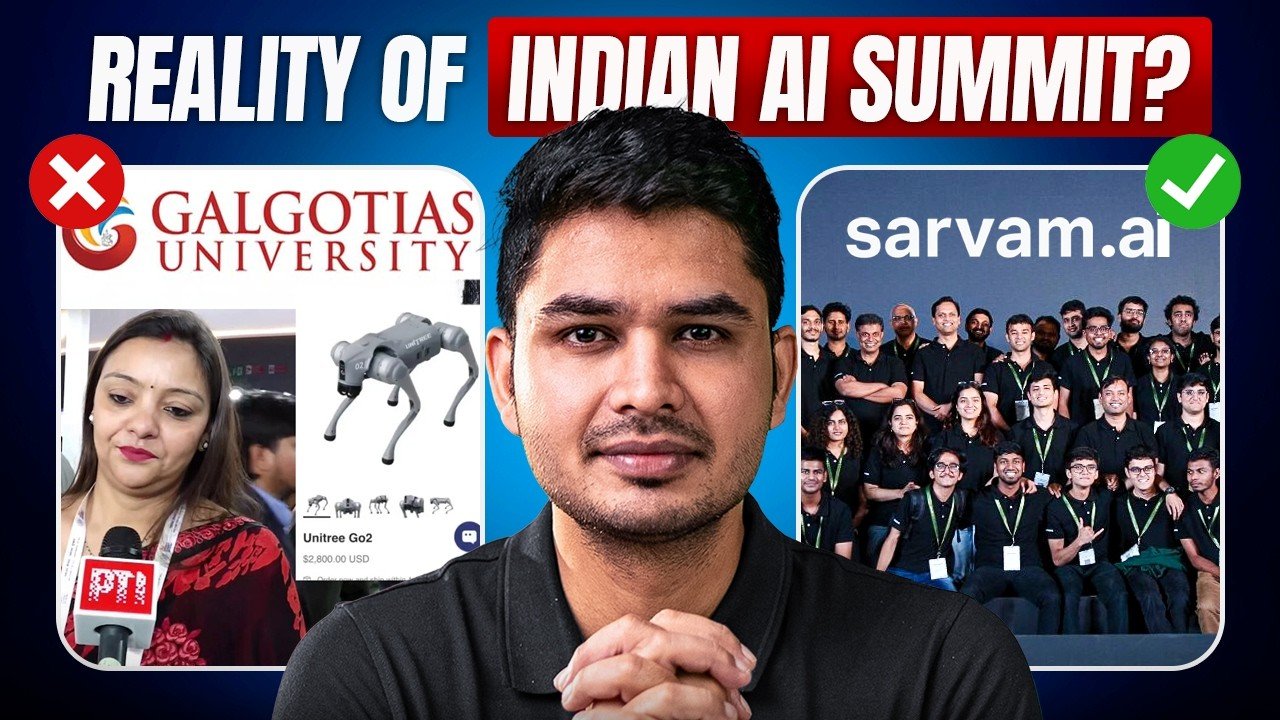
While the internet buzzed with a viral story about a university presenting a Chinese robot dog as its own creation, a much more significant narrative was unfolding just meters away. India’s biggest AI announcements in history were made, yet largely went unnoticed. Welcome to an exploration of the true innovations emerging from the heart of India’s tech ecosystem.
The Irony and India’s True AI Prowess
The recent India AI Impact Summit presented a stark contrast. On one side, a university garnered widespread attention for showcasing a commercial Chinese robot dog, retailing at around $1,600, as an indigenous innovation. The subsequent online outrage and media frenzy overshadowed the genuine technological advancements being made. Yet, at the very same summit, a pioneering startup was quietly demonstrating India’s actual leaps in robotics.
Extrera Robotics: India’s First Commercial Quadruped Robot
IIT Kanpur startup Extrera Robotics unveiled the Swan M2, India’s inaugural commercial quadruped robot. This industrial-grade marvel, designed and built entirely in India, was showcased by L&T for real-world industrial applications. Unlike the widely publicized controversy, the Swan M2 is no mere toy. It navigates challenging construction sites, climbs stairs, handles rough terrain, and boasts a 5 kg payload capacity. L&T, India’s largest engineering company, is actively evaluating its deployment across their construction projects, proving it’s a tangible product, not just a concept. Unfortunately, this significant innovation was largely overshadowed by the viral scandal.
Serum AI: Positioning India as a Global AI Powerhouse
Amidst the drama, Serum AI made three pivotal announcements that could firmly establish India as a major global AI player. Their strategy focuses on creating practical, accessible AI solutions tailored for the Indian context.
Serum’s AI Smart Glasses: India-First Innovation
Serum introduced its first AI smart glasses, a ready-to-use product slated for launch in May 2026. These are not merely camera glasses; they feature built-in AI that supports 10 Indian languages and operates offline using edge AI models. The platform is also open for developers to create custom applications. This innovation promises real-world impact:
- Farmers in rural areas can get immediate disease detection advice for crops in their local language.
- Small shopkeepers can manage inventory using voice commands in Hindi.
- Healthcare workers can benefit from real-time language translation for diverse patient populations.
This approach stands in contrast to products like Meta’s Ray-Ban smart glasses, which cost around 30,000 rupees and primarily function best for English speakers.
Cutting-Edge Large Language Models (LLMs)
Serum also launched two significant LLMs:
- Serum 30B: This 30-billion parameter model utilizes a Mixture of Experts (MoE) architecture, allowing it to activate only about 1 billion parameters at any given time based on the query. This results in a four to six times faster performance than traditional models of comparable size. A demonstration even showcased its AI chatbot, Vicram, running on a basic feature phone, with HMD and Nokia announcing plans to integrate Serum’s AI chatbot directly into these devices.
- Serum 105B: A formidable 105-billion parameter model, capable of handling 128,000 tokens of context in a single session. Live demonstrations at the summit included analyzing company balance sheets, answering complex financial queries, and generating on-the-fly business insights. Serum claims this model performs on par with frontier models but at a significantly lower cost, making it more affordable than Google’s Gemini Flash.
A Strategic Vision: Utility Over Size
While the US and China focus on building the largest possible AI models (GPT-4 and Gemini in the trillion-parameter range), India is charting a different course. Serum AI is not aiming to win the “size race” but rather to develop the most useful AI for India. This involves creating models that can run on feature phones, genuinely support 22 Indian languages, function offline in areas with limited connectivity, and are priced affordably (around one rupee per minute). This strategy positions India as potentially the world’s most significant AI laboratory, providing affordable, useful AI in local languages to 1.4 billion people. This echoes the success of UPI, which in 2016 was doubted but now processes more transactions daily than Visa, demonstrating India’s ability to build inclusive digital public infrastructure.
India’s Space Tech Soars to New Heights
Beyond AI, India’s private space sector is making monumental strides, highlighted by Skyroot Aerospace.
Skyroot Aerospace: Vikram 1’s Orbital Ambition
Skyroot Aerospace is on the verge of launching Vikram 1, India’s first commercial orbital rocket. Its second and third stage engines have arrived at the Sriharikota spaceport for pre-flight checks, signaling the imminent launch. This isn’t Skyroot’s first foray; in January 2022, their single-stage suborbital rocket, Vikram S (named “Prarambh”), made history as the first private Indian company to send a rocket to space. That mission, reaching an altitude of 89 km and Mach 5, served as a crucial proof of concept.
Vikram 1, however, is the main event. Standing 20 meters tall and constructed almost entirely from carbon composites, this three-stage rocket can carry up to 350 kg to Low Earth Orbit and be launch-ready within 24 hours of reaching the pad. Its Kalam 250 engine in stage two can achieve a peak thrust of 235 kilonewtons in vacuum, while stage three provides the precise final push for satellite insertion. Its successful launch will mark India’s first private orbital rocket launch, a monumental achievement that validates India as a genuine competitor in the global small satellite launch market, an arena currently dominated by established players like SpaceX.
To maintain its competitive edge, Skyroot is in advanced talks to raise $200 million (1,800 crore rupees), potentially valuing the company close to $1 billion and making it India’s first space tech unicorn.
Pixel Space Partners with Exotrail
In other space tech news, Pixel Space has collaborated with French electrical propulsion company Exotrail. This partnership will see Exotrail’s SpaceWare electric propulsion system integrated into Pixel’s upcoming satellites, enhancing maneuverability, extending mission life, and improving end-of-life disposal through 2027.
Startup Ecosystem: Key Updates and Funding Rounds
Anthropic Establishes Indian Presence
Anthropic, the US-based AI company behind the Claude LLM, has opened its first Indian office in Bengaluru. This move underscores India’s importance as Claude’s second-largest market globally. Led by former Microsoft India MD Arena Go, Anthropic plans to deepen enterprise partnerships and offer applied AI expertise to Indian businesses, positioning Claude as a significant B2B AI tool in a market projected to reach $126 billion by 2030.
Corover’s Offline AI Device
AI startup Corover has launched the Bharat GPT desk appliance, an offline AI device that brings its Bharat GPT platform directly to desktops without requiring an internet connection. Powered by Nvidia’s Grace BlackBear architecture and bundled with Corover’s foundational Bharat GPT mini model, this device enables local and secure AI operations. This is a significant advantage for enterprises, defense, BFSI, and public sector use cases where data privacy is paramount.
Indian Startups Secure Substantial Funding
This week saw a significant surge in funding for Indian startups, collectively raising $1.26 billion, a substantial increase from the previous week’s $259 million. Notable funding rounds include:
- Nascent.ai (Velocus): The Mumbai-based AI cloud platform, which allows companies to rent powerful GPUs and tools for building, training, and running AI models, raised $1.2 billion, achieving unicorn status.
- C2I Semiconductors: This Bengaluru-based company, designing smart power management chips to enhance efficiency in AI data centers by optimizing electricity flow, secured $15 million.
- Petrus Biotech: A Bengaluru-based biotech startup utilizing AI for accelerated drug discovery (scanning millions of molecules for candidates against diseases like cancer and inflammation), raised $7.7 million (70 crore rupees) in its Series A round.
- Home Run: A quick commerce platform based in Bengaluru, delivering construction and home improvement materials within 60 minutes, raised $6.6 million (60 crore rupees) in its Series A round.
- Pluto Mobility: This EV startup, building electric vehicles specifically for last-mile delivery, including compact, enclosed four-wheeler scooters, secured $2 million in its seed round.
From groundbreaking AI tailored for local languages to ambitious private space missions and a vibrant startup funding landscape, India is quietly but definitively making its mark on the global technology stage. The focus on utility, affordability, and indigenous innovation is paving the way for a unique and impactful tech future.